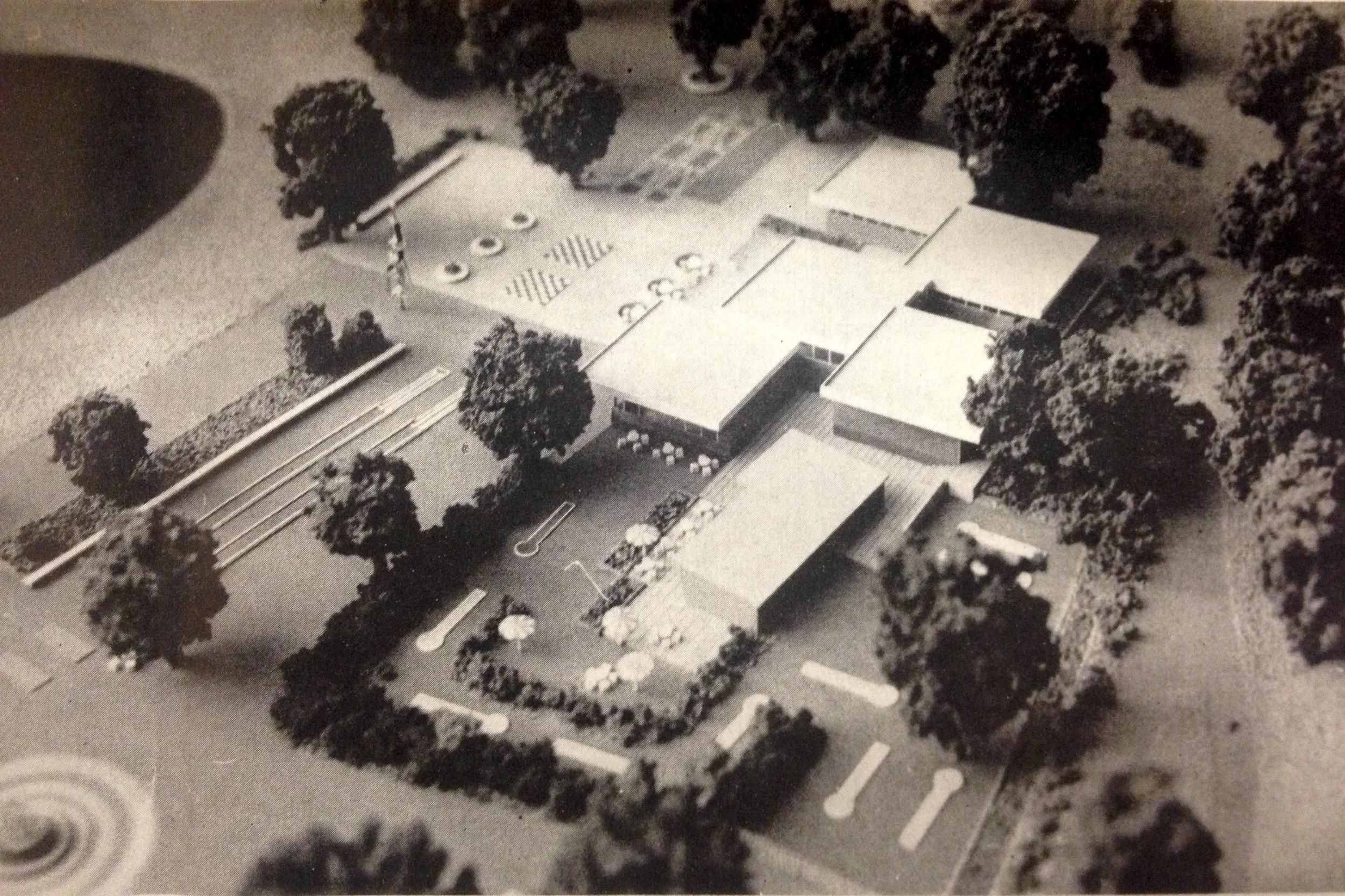
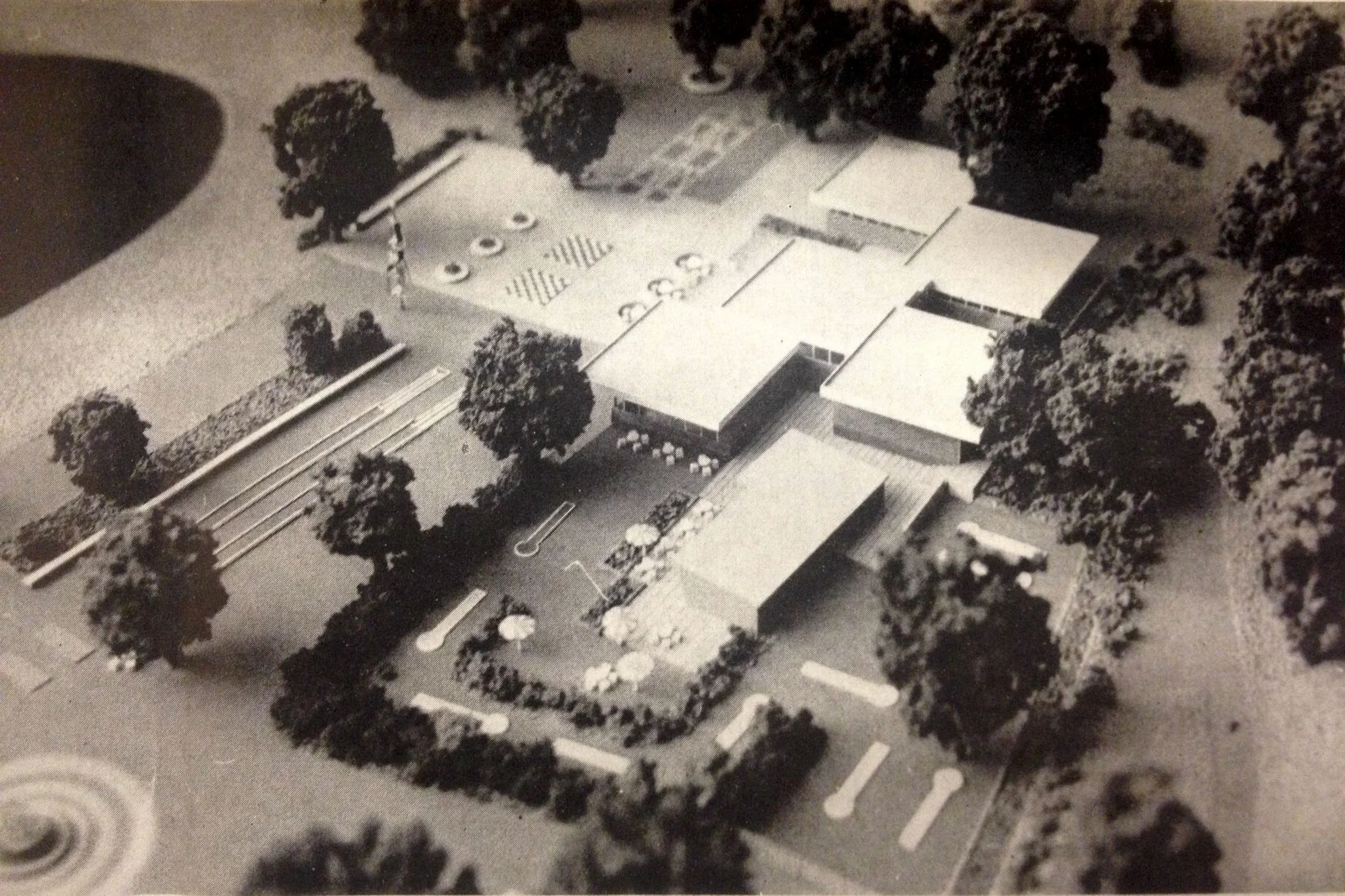
The pavilion originated as a small library, which was later expanded as an initiative project by an ambitious group and, with great attention to detail, won the competition for the 10th World Festival of Youth and Students in 1973.
Design: Dipl. Architect Prof. BdA/DDR Dietmar Kuntzsch,
Berlin Academy of Art 1972
Other people involved in this project
DIRECTORY
Key figures
Total area of the leisure park (excluding pavilion): 34,665 m²
Gross area of the 5 pavilions: 466 m²
enclosed enclosed space, 1,940 m³
projecting roof area (rain protection), 184 m²
open enclosed space, 698 m³
Price per m³ (average, building construction/enclosed space): €255/m²
Details regarding implementation
Planning for the leisure centre began in January 1972, based on the study for the redesign of the historically established public park / Construction began in August 1972 / Handover to the public by the mayor of the capital in June 1973 on the occasion of the 10th World Festival of Youth and Students.
Urban planning situation
Various areas and facilities for sports and recreational activities, some of which are also used for school sports, were integrated into the park, and the provision of sports facilities, restaurants, and restrooms for visitors was ensured through the construction of buildings. The leisure center is part of the planned reconstruction of the historically established public park. It primarily serves the neighboring, densely populated older districts of Friedrichshain and Prenzlauer Berg as a place for active recreation.
Open spaces
The leisure park, situated between two bunker hills, consists of two sections
the play area in the eastern and
the sports area in the western part
Together with the pavilion ensemble, the play area is the center of the entire complex and contains attractive facilities such as asphalt bowling, ring toss and giant chess.
The space in front of the terrace offers room for temporary, attractive play facilities, dance events, bazaars and other activities on holidays such as the ND press festival.
The existing reading room, which was unsatisfactory in appearance, now recedes into the background and serves as the starting point for a reading and sunbathing garden, to which a mini-golf garden is attached.
Skittles, shuttleball, curling, shuffleboard and table tennis complete the facilities of the play area, which is divided by existing trees, shrub areas and raised beds with colorful floral decorations.
The walk-in fountain forms the visual focal point between the board game areas in the rose garden, the seating area by the pond and the subsequent planned rose garden.
The entire play centre is paved with a bituminous black surface, into which light plastic surfaces are embedded as a contrast to create important facilities and main connections.
All walls and seating walls were planned to be constructed of pebble-washed concrete.
The sports area includes, in addition to the large multi-purpose sports field, a volleyball/badminton/Indiaca court, two bocce courts and a tennis court facility with three courts, which is used as an ice rink in winter.
A long jump pit, a gymnastics area, and a table tennis area complete the facility, which is rhythmically divided into manageable sections by rows of trees. With the exception of the sports fields themselves, the surfaces of the sports area are covered with a water-bound surface. The sports fields have a wear-resistant asphalt surface, while the tennis courts have special water-bound surfaces.
The five pavilions are designed as reusable functional units and are grouped at the Friedrichshain leisure centre in such a way that meaningful connections to adjacent open spaces are created and, through offsets in the floor plan and heights, an ensemble is created that integrates favorably into the park situation while preserving all the large green spaces and using the minimum built area.
The pavilions fulfill the following functions:
Sports support pavilion:
Storage and rental of sports and play equipment, accommodation for sports staff, first aid, telephone, technical rooms
Conditioning pavilion
with training equipment for 15 active athletes, sports medicine testing equipment. Sports pedagogical task.
Changing and sanitary pavilion:
Changing facilities, shower cubicles and toilet facilities for the pavilion and open areas
Restaurant pavilion,
self-service restaurant with 24 indoor and 70 outdoor seats, kitchens and staff rooms with adjoining, enclosed service yard.
Games pavilion
equipped with billiard tables, chess tables and 20 additional seats in conjunction with the restaurant pavilion.
The load-bearing structure consists of reinforced concrete, which is visible as formwork rough at the columns and cantilevered roof zones with profiled edges.
Lightweight, prefabricated steel elements with thermal glazing in the window areas form the facade, where the light-colored panels with their dark green facade mullions contrast with the striking red-orange door panels made of polyester. White logos on the door panels symbolize the spaces behind them (telephone, restaurant, etc.)
The exposed concrete, the ochre-colored exposed brickwork (clinker) for the partition walls and the natural-colored pine wood ceilings – maintenance-free and age-resistant materials – together with the tint of the facade and the sculptural terracotta-red balustrade elements of the terrace form a material and color combination that is coordinated with the surroundings of the leisure park.
The pavilions are used in all seasons and heated by individual gas heaters in winter.
* Initiative projects were described as those not originally included in the plans of the former GDR. ( see planned economy)